

While genetics play an important role,
a child’s development is also deeply influenced by their environment.
The wide range of experiences and exposures they encounter
where they interact, live, grow, play, and learn.
These environments can shape children in
both positive and negative ways.
POSITIVE EARLY EXPERIENCES:
-
Appropriate Stimulation
-
Nurturing caregiving
-
Rich social intereaction
Build healthy circuit formation and support healthy long-term cognitive outcomes.
NEGATIVE EARLY EXPERIENCES:
-
Trauma
-
Neglect
-
Prolonged Stress
Shaping the brain in harmful ways and increasing the risk of mental health over time.
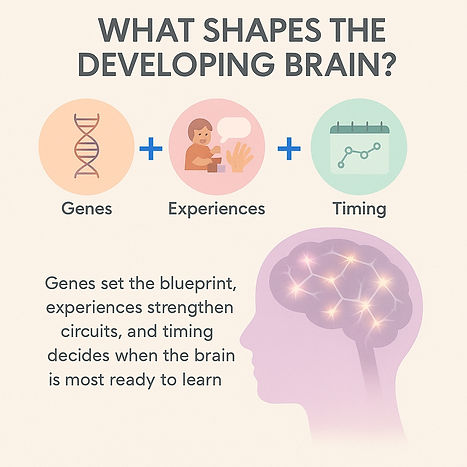
Nature and Nurture Work Together,
TIMING Shapes the Story!
What is a “critical period” in brain development?
Critical periods are brief yet powerful stages in infancy and early childhood when the brain is highly receptive to learning specific skills and
adapting to its environment.
During this time, neural connections form rapidly, laying the foundation for future learning, behavior, and emotional well-being.

AREAS OF GROWTH
Source: Nelson, C. A. in Neurons to Neighborhoods (2000), Shonkoff, J. and Phillips, D. (Eds.)
The graph illustrates human brain development before and after birth, highlighting the months leading up to and the first year following birth as a period of rapid synapse formation. Lack of stimulation during this critical stage can disrupt the development of sensory pathways, language and speech abilities, and complex cognitive functions.
Sensitive Period
Neuroscience confirms the existence of critical and sensitive periods of development, validating Maria Montessori's observations of children's innate abilities to absorb specific skills at certain times.
Though the terms have different meanings, both describe windows of heightened brain plasticity during early childhood when a child is primed for specific types of learning.
Montessori Sensitive Periods
From Birth to Age Six


AREAS OF DEVELOPMENT
Writing & Reading skills
This chart illustrates the sensitive periods identified by Dr. Maria Montessori. It shows unique windows of time during early childhood when a child’s brain is especially receptive to learning certain skills. During these stages, children are naturally drawn to specific types of experiences and learn effortlessly through exploration and repetition.
Supporting Your Child Through Sensitive Periods
During the sensitive periods of early childhood, children are especially open to learning and growth. As parents and educators, we can guide them with care and understanding.
Observe and Follow the Child
Watch your child closely. Their interests reveal what they’re ready to learn. Provide freedom to explore in a calm and supportive space.
Prepare the Environment
Design your home or classroom to be orderly, accessible, and child-centered. A well-prepared space supports independence and natural learning.
Offer Meaningful Materials
Prepare age-appropriate and engaging materials that match your child’s current stage. For example, books and storytelling during the language period, or sorting and building activities during the order period.
Create Consistency and Calm
A predictable daily rhythm helps children feel secure and focused, especially during times when their sense of order is developing.
Encourage Independence
Allow your child to do things for themselves: dressing, cleaning up, or choosing activities. These moments build confidence and self-reliance.
Be Patient and Trust the Process
Each child develops at their own pace. Offer gentle support and encouragement as they move through each sensitive period.
Sensitive periods are windows of great potential.
We must carefully observe each child’s unique characteristics and provide meaningful experiences that nurture their growth during these golden years.
With the right support and protection, children can fully unfold their greatest potential.


